
We are drowning in data, yet starving for trusted insights. Over my career in global development and statistics, I have watched a recurring tragedy unfold: the world’s most pressing challenges cross borders effortlessly, while our systems for measuring them remain deeply fragmented and dangerously slow.
For too long, global statistical institutions have acted as historians, publishing retrospective reports years after a crisis has fundamentally shifted. We paid a devastating price for this lag in 2008, when backward-looking macro indicators failed to detect the systemic contagion that collapsed the global economy. We witnessed it again when COVID-19 hit—our traditional data systems were simply too slow to capture the real-time implosion of global supply chains and the immediate vulnerabilities of marginalized communities.
In a rapidly evolving world, recording history is no longer enough. We must provide the real-time, trusted foundation that empowers global leaders to shape it. If we want to build a stabilizing backbone for international governance and ensure that we truly leave no one behind, we must fundamentally transform the global statistical system. This transformation requires confronting four deeply entrenched standoffs:
1. Dismantling the “Tyranny of Averages” Global reporting frequently celebrates macro-level progress while completely erasing sub-national realities. When a global body reports that a structurally diverse nation has achieved stable GDP growth, financial markets applaud. Yet, this aggregate metric acts as a statistical mask. It obscures the reality that while mega-cities capture digital growth, rural provinces are simultaneously reeling from climate shocks and acute water scarcity. This statistical erasure is devastating for human development, particularly for women and girls. A global scorecard highlighting a 90% national primary school enrollment rate offers no comfort when that average is driven exclusively by affluent urban centers. In remote districts, girls’ enrollment may quietly stagnate below 40% due to entrenched infrastructural and economic barriers. We must remember that data is not just numbers; it is people. Relying on national averages means humanitarian aid is chronically miscalculated, leaving the most vulnerable populations behind. We must explicitly measure dispersion and multi-dimensional vulnerability so that no individual is ever flattened into a broad national average.
2. Beyond Surveys: Building a Dynamic “State of Knowledge” We can no longer rely exclusively on traditional censuses and sample surveys. The era of settling for static “snapshots” that diagnose a fragment of reality, only to lose their relevance as time passes, is over. We urgently need to integrate all data streams to build a comprehensive, multidimensional “State of Knowledge” on every development and humanitarian issue. using administrative records, big data, remote sensing, and alternative data with traditional statistical frameworks does more than just enable early warning and real-time crisis response. It creates a rich, profound statistical infrastructure that fuels in-depth academic research, enables sophisticated trend analysis, and allows us to forecast development trajectories with unprecedented confidence.
3. The Collision of AI and National SovereigntyTo achieve this hyper-local precision before a crisis deepens, we must aggressively integrate Artificial Intelligence. By utilizing AI to synthesize unconventional, high-frequency data, satellite imagery of crop yields, localized mobile money flows, anonymous digital learning pattern, we can flag drop-out risks or food supply collapses at the village level long before official surveys are compiled. But this triggers a fierce geopolitical conflict. Many governments view real-time external monitoring as an intrusive violation of domestic authority. Datasets tracking health and education contain highly confidential personal information. Demanding that sovereign states hand over raw, unencrypted domestic registries is a guaranteed recipe for diplomatic deadlock.
4. Redefining Data Statecraft Through Privacy-Enhancing Tech The resolution lies not in political coercion, but in advanced privacy-enhancing technologies. As leaders, we must redefine data sovereignty for the digital age: not as a government’s right to hoard information, but as its right to securely govern and benefit from a shared global ecosystem. Through federated learning, raw data remains securely locked on national servers. The machine learning models travel to the data—not the other way around. They analyze local patterns of inequality and transmit only encrypted, mathematical insights back to the global repository. The nation’s digital sovereignty is fully respected, citizen confidentiality is mathematically guaranteed, and the international community gets the high-fidelity data it needs to coordinate collective action.
Speed vs. Rigor: A False Choice Statistical purists often argue that prioritizing speed and unconventional data compromises scientific accuracy. But as the blind spots of 2008 and 2020 proved, waiting two years for a flawless report during a fast-moving crisis is a form of policy failure. An immediate, 90% accurate real time estimate is exponentially more valuable to a decision-maker facing a climate disaster than a perfect retrospective analysis that arrives after the damage is irreversible.
The role of a global statistical leader is no longer just a technical mandate; it is a profound diplomatic and civic responsibility. By modernizing our data architecture, moving from static surveys to a dynamic “State of Knowledge,” and utilizing privacy-preserving AI, we do not just change how the world counts. We provide the clarity, equity, and mutual trust required to solve our species’ greatest challenges. It is time to build a global data infrastructure worthy of the complex world we are tasked to navigate.
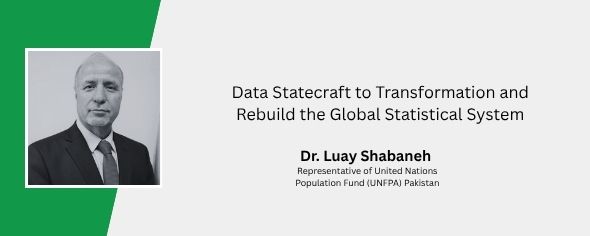
Writer:
Dr. Luay Shabaneh, Representative of United Nations Population Fund (UNFPA) Pakistan